
Palenque Ruins: The Complete Visitor Guide (2026)
Palenque is the best-preserved Maya city you can walk through in Mexico, and one of the few where the jungle still crowds every plaza. It sits about 8 km from the town that shares its name, in a national park on the first forested hills above the Gulf plain. You do not need a tour. You do need to know that there are two separate entrance fees, that both jumped sharply in 2026, and that arriving at 8am instead of 11am is the difference between a quiet ruin and a coach-party scrum in 32°C heat.
Key Takeaways
Two fees, paid separately in 2026: the CONANP national-park fee (225 pesos foreigners / 115 Mexicans and residents) and the INAH site fee (210 / 105). Budget 435 pesos (about $24 USD) as a foreigner. Cash only.
Open daily 8:00am–5:00pm, last entry 4:00pm. Arrive at opening — San Cristóbal tour buses land around 11am and the heat builds fast.
Colectivos run constantly from Avenida Juárez in town: 20–25 pesos, 20 minutes. A taxi is about 100–150 pesos.
Give it 3–4 hours. The Temple of the Inscriptions is roped off (Pakal's tomb sealed), but you can still climb the Palace and the Cross Group.
The on-site museum has been closed on and off for renovation since 2024 and is unreliable in 2026 — check the same day before you count on it.
The Short Answer for Visiting
Take a colectivo from Avenida Juárez in Palenque town (20–25 pesos, ~20 minutes). You pay the CONANP national-park fee at a checkpoint on the way in, then the INAH site fee at the main entrance — as a foreigner in 2026, roughly 225 + 210 = 435 pesos, cash, about $24 USD; Mexicans and residents pay about half.
Arrive at the 8:00am opening, walk the core group, then take the jungle path downhill past the unexcavated mounds and stream cascades to come out near the museum. Plan on 3 to 4 hours.
The Two Entrance Fees, Explained
People get confused here. Palenque is both an INAH archaeological site and a CONANP national park, run by two different federal agencies, and each charges its own fee.
The national-park fee (CONANP). Collected at a checkpoint on the access road below the ruins — your colectivo stops, everyone pays, you get a wristband good for five days. In 2026 it is roughly 225 pesos for foreign visitors, 115 pesos for Mexicans and foreign residents, 55 pesos for students and teachers (Cuarto Poder). Some 2026 reports say it is now also sold alongside the INAH ticket at the main visitor center — either way, you pay it.
The site fee (INAH). Paid at the ticket windows at the main entrance (the CATVI visitor center). In 2026 it is 210 pesos for foreign visitors and 105 pesos for Mexican nationals and foreign residents; the site is open daily 8:00 to 17:00, last entry 16:00, and Mexican citizens enter free on Sundays — though the free Sunday entry waives this INAH fee only, so you still pay the CONANP park fee (INAH).
Both fees roughly doubled for 2026 in a nationwide INAH and CONANP price update — Palenque is a Category I site, the top tier. The old combined price of around 90–130 pesos you will still see in older blog posts is gone. Bring cash; card payment is unreliable and there is no ATM at the ruins.
How to Get to the Palenque Ruins from Town

Colectivo. What almost everyone does. Shared vans marked "Ruinas" leave constantly — every 10 to 20 minutes, roughly 6am to 6pm — from Avenida Juárez, the main drag through town, with pickup points near 5 de Mayo and the ADO terminal. The fare is about 20–25 pesos each way (a few ask up to 40), and the ride is 20 to 25 minutes. They run often enough that getting out there is never the part to worry about — walk to Avenida Juárez, flag one down, climb in. Catch the same vans on the road to come back.
Taxi. About 100–150 pesos one way, more if the driver waits. Worth it for a group of three or four.
On foot. It is about 8 km, and I have walked it. It is a long, sweaty haul in the jungle humidity and mostly uphill, but a genuinely pretty one through forest the whole way. Worth doing if you have the morning and you are not in a rush; otherwise ride out and save your legs for the site.
By bicycle. The nicest way in, if your guesthouse has bikes to lend or rent. There is a marked bike path along the road for much of the distance, the grade is manageable, and you skip waiting for a colectivo in both directions.
On a tour. Day tours from San Cristóbal bundle Palenque with Agua Azul and Misol-Há in a brutal 12–14 hour push that gives you barely 90 minutes at the ruins, arriving mid-morning with everyone else. If you care about Palenque, base yourself in town — see where to stay in Palenque — and give the site its own morning.
Opening Hours and the Best Time of Day
The site opens at 8:00am and closes at 5:00pm, with last entry at 4:00pm. Ticket windows are sometimes slow, so gates can lag to around 8:30.
Be there for opening anyway. I have only ever gone at 8am, and it is the one piece of advice here I would not bend on. Two things converge around 11am: punishing dry-season heat with almost no shade in the plazas, and the tour buses from San Cristóbal, which — like almost everywhere in Mexico — do not start rolling until 10 or 11 and then keep coming into the afternoon. The first 90 minutes you can photograph the Palace with nobody in the frame; by noon you are queuing to climb the Cross Group. Starting early also gets you back to town before the worst of the afternoon sun.
Howler monkeys are loudest and closest in that early window — you will hear them roaring from the forest around the Cross Group and the jungle path, and often see them, plus agoutis crossing the trails.
How Long You Need at Palenque
Three to four hours for the core site at a normal pace, including the walk out through the jungle. A fast loop of the main plaza takes 90 minutes but you will skip things; archaeology fans and photographers can spend five or six hours. Half a day is the honest answer, which is why afternoon-arrival tours shortchange you.
What to See: The Main Structures
The core group is compact — everything below is within a 15-minute walk.
Temple of the Inscriptions and Pakal's Tomb
The stepped pyramid on the south side of the plaza is the tomb-temple of K'inich Janaab' Pakal, the ruler who built Palenque's golden age in the 7th century. His sarcophagus, with its famous carved lid, was found in a vaulted chamber deep inside in 1952. You can no longer climb it. The staircase is roped off, and the tomb has been sealed since 2004 to stop humidity and visitor breath from destroying the stucco. You view it from the plaza; the sarcophagus lid in photos is a replica in the on-site museum.
The Palace
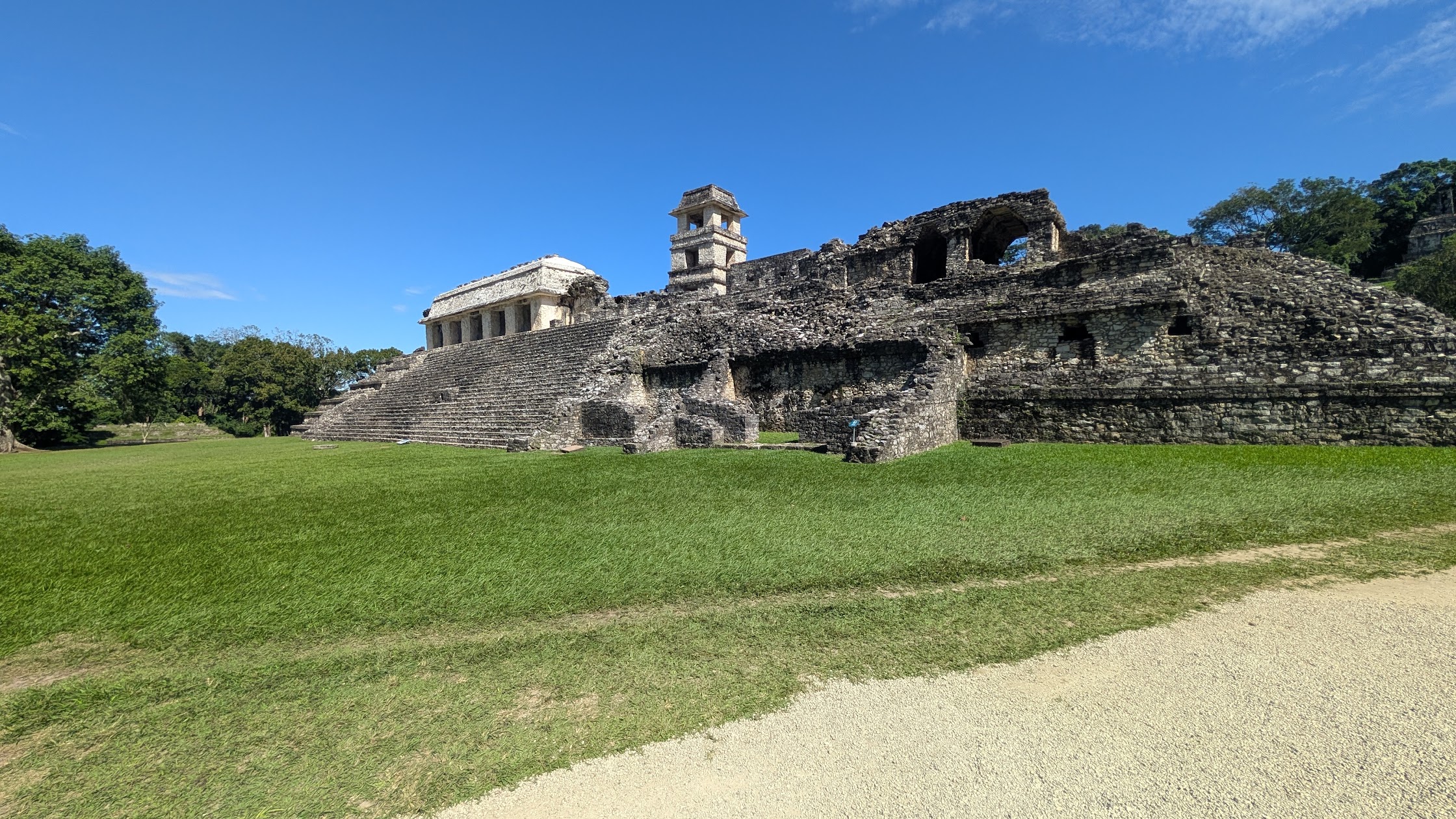
The sprawling complex in the middle of the site, built up over generations, with courtyards, galleries, a maze of vaulted rooms, and a four-story tower that is probably an observatory — unique in the Maya world. You can walk through most of it, up the main stairs and around the courtyards with their carved stone captives. The tower is fenced off, but the rest is the most immersive part of Palenque: you are inside the rooms, not roped out of them.
The Cross Group
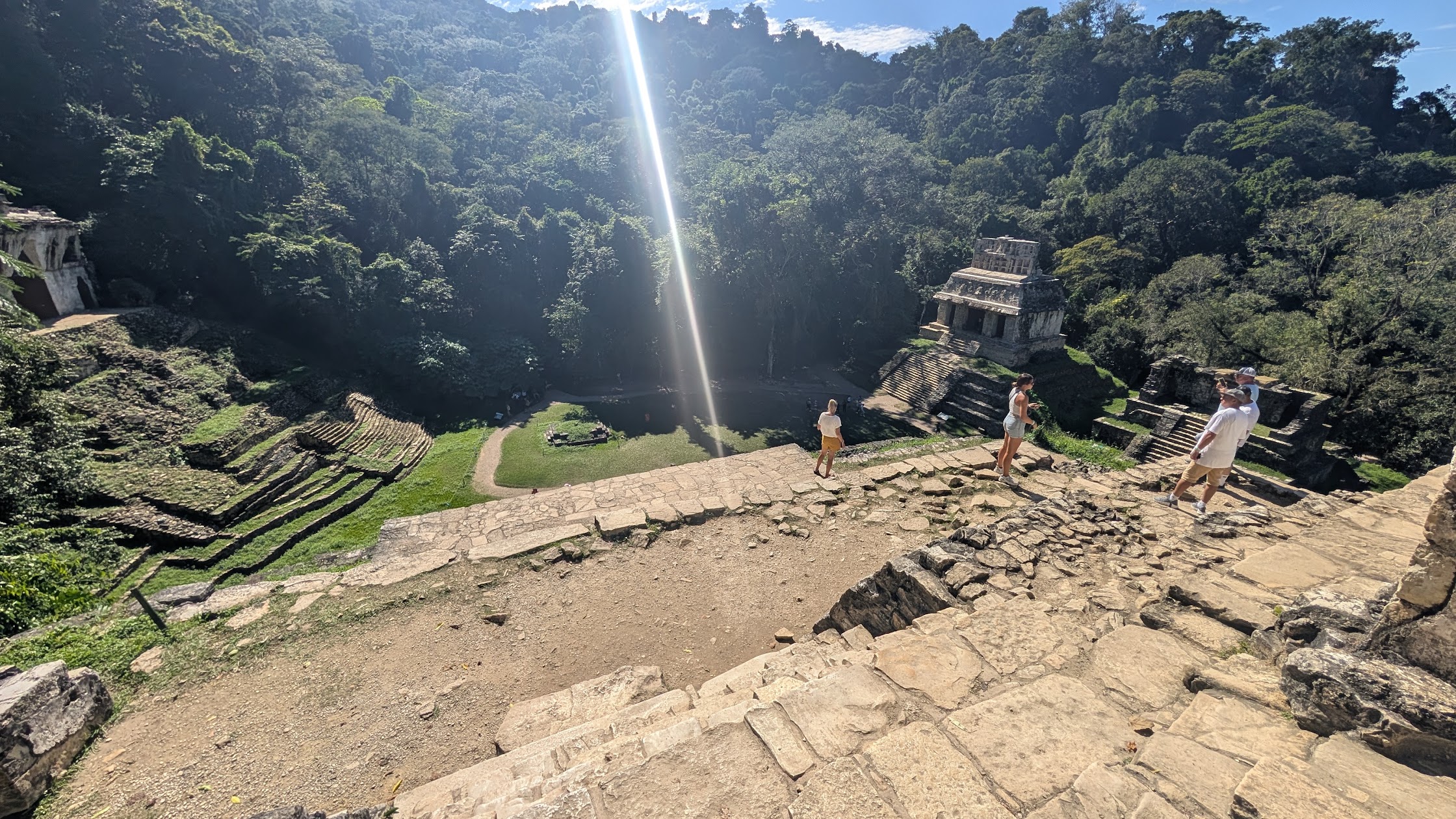
Three pyramids facing a shared plaza on the east side — the Temple of the Cross (tallest, best view back over the site), the Temple of the Sun, and the Temple of the Foliated Cross. Each has a roofcomb and an inner sanctuary with a carved tablet. You can still climb all three, so go up the Temple of the Cross before the steps fill.
Temple XIII, the Red Queen, and the North Group
Next to the Temple of the Inscriptions, Temple XIII held a second sealed tomb found in 1994: a woman in a stone sarcophagus, her bones and jade coated in bright red cinnabar, most likely Pakal's wife Tz'akbu Ajaw. You can usually walk a short lit passage into the base to see the sarcophagus. Toward the jungle exit, the Temple of the Count and the North Group are quieter — where the manicured site turns back into forest.
The Jungle Path, the Waterfalls, and the Museum — Walk Downhill
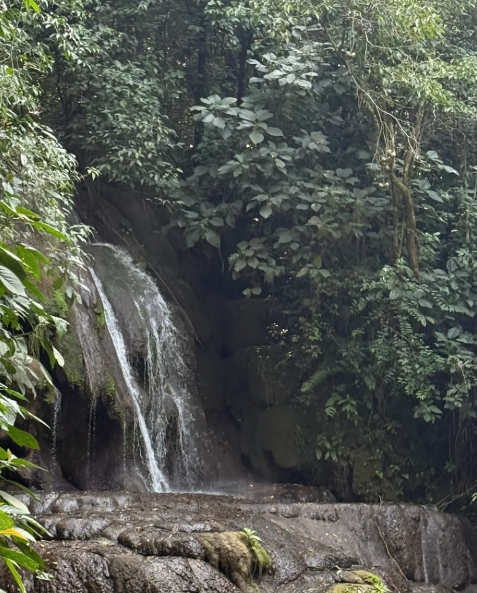
Do not backtrack to the main entrance. From the North Group, a marked path drops into the forest and follows the Otulum stream downhill for about 1.5 km. You pass unexcavated mounds with trees growing out of them, cross footbridges, and walk alongside a chain of cascades and pools called the Baño de la Reina (Queen's Bath). Swimming is roped off now, but it is a beautiful, shaded 40-minute walk that does the elevation the easy way — one of the better parts of a Palenque visit, and I would not skip it.
The path comes out near the Alberto Ruz Lhuillier site museum, about 1.5 km down the access road from the main gate. It holds the full-size replica of Pakal's sarcophagus lid, the Red Queen's remains and jade, and the best stucco and tablet fragments. It reopened in September 2024 after a Tren Maya–funded renovation — the exhibits still feel new — then closed again for further work around October 2025 and, as of mid-2026, has not reliably reopened (INAH). Even when open its hours are erratic and there is often little going on first thing in the morning, so check the same day rather than building a plan around it. When it is open it is worth about an hour. From the museum road, flag a colectivo back to town.
Is a Guide Worth It?
I am not a big fan of guides here. There is a sign in front of most of the structures laying out its history, and a downloadable walking-guide app — several cover Palenque, from the App Store or Google Play — takes you round with much the same material a guide would give you, at your own pace. The carved tablets do reward someone walking you through them, so if this is the one big Maya site of your trip and you want that depth, the INAH-licensed guides at the main entrance charge roughly 800–1,200 pesos for a private two-hour tour for a small group, less per person if you join others; check for the official ID badge. Otherwise, save the money — take the app, read the signs, and explore on your own.
What to Bring
There is no shade in the plazas, the humidity is high, and rain is possible in any month — Palenque sits in one of the wettest corners of Mexico. Bring more water than you think, sun cover, a rain layer, and shoes with grip for the wet stone and muddy jungle path. Drones are prohibited; there is a café and toilets at the main entrance.
Only a Fraction of Palenque Is Dug Out
What you walk through is the ceremonial core and almost nothing else. Less than 10% of the city has been cleared and stabilized — some archaeologists put it closer to 5% — with well over a thousand structures still buried under the forest across the 1,780-hectare park. The mounds you pass on the jungle path are buildings. You are standing in a cleared plaza inside a city that is still mostly jungle.
Palenque was not the only power here, either. Toniná, a steep hill-city near Ocosingo, was its long-running rival and captured a Palenque king in 711 — worth a stop if ruins are your thing Toniná: Chiapas' tallest pyramid. Deeper in the Lacandón jungle, Yaxchilán and Bonampak are the harder-to-reach payoff.
The Bottom Line
Palenque is worth building a trip around, and it is easy to do independently. Take the early colectivo from Avenida Juárez, carry about 435 pesos in cash for the two fees, be through the gate at 8am, climb the Palace and the Cross Group before the buses, and walk out downhill through the jungle past the Queen's Bath. Give it a full morning. For the town, food, and where to sleep, see the full Palenque area guide and things to do in Palenque beyond the ruins; for the waterfalls south of here, Agua Azul and Misol-Há; and to fit it together, how many days you need in Chiapas, the independent Chiapas guide, and the unfiltered things-to-do list.
Frequently Asked Questions
How much does it cost to enter Palenque?
Two separate fees in 2026: the CONANP national-park fee (about 225 pesos for foreigners, 115 for Mexicans and residents) and the INAH site fee (210 pesos for foreigners, 105 for Mexicans and residents). A foreign visitor pays roughly 435 pesos total, about $24 USD, in cash. Both roughly doubled for 2026.
How do you get to the Palenque ruins from town?
Take a colectivo marked "Ruinas" from Avenida Juárez in Palenque town. They leave every 10–20 minutes from around 6am to 6pm, cost about 20–25 pesos each way, and take 20 minutes. A taxi is about 100–150 pesos one way. The ruins are roughly 8 km from town.
Can you climb the pyramids at Palenque?
Some. The Temple of the Inscriptions (Pakal's tomb) is roped off, and the tomb has been sealed since 2004. But you can still climb the three pyramids of the Cross Group and walk through most of the Palace, including its stairs and courtyards. The Palace tower is fenced off.
How long do you need at Palenque?
Three to four hours at a normal pace, including the jungle-path walk down to the museum. A rushed loop of the main plaza takes about 90 minutes; archaeology fans and photographers can spend five or six hours. Plan a half day.
Is a guide worth it at Palenque?
Not for most people. There is a sign in front of most structures with its history, and a downloadable walking-guide app covers Palenque with much the same material a guide would, at your own pace. The carved tablets do reward a real explanation, so if this is the one big Maya site of your trip, a licensed guide at the entrance — about 800–1,200 pesos for a small-group private tour — is worth two hours. Otherwise, take the app and read the signs.
What time do the Palenque ruins open?
Daily at 8:00am, closing at 5:00pm with last entry at 4:00pm. Gates sometimes open closer to 8:30. Arrive at opening regardless — it beats both the midday heat and the tour buses that arrive around 11am.