
Monte Albán & Mitla: A Complete One-Day Trip Guide
Monte Albán and Mitla are the two archaeological sites most visitors put at the top of their Oaxaca list, and both are doable in a single day if you plan the order right. This guide covers how to get to each site, what tickets involve, and how to time the day so you're not rushing the second stop. For the bigger picture of where this day trip fits into a longer visit, see our Oaxaca travel guide and our breakdown of how many days to spend in Oaxaca. If ruins aren't the only thing on your list, our guides to mezcal village tours and Oaxaca's artisan villages cover the other classic Central Valley day trips.
Key Takeaways
Monte Albán and Mitla are separate sites in opposite directions from Oaxaca City, so doing both in one day means a full day, not a half day.
The efficient order is Monte Albán first thing in the morning, then Mitla in the early-to-mid afternoon.
Monte Albán sits on a mountaintop about 20 minutes from downtown; Mitla is roughly 40-45km east, closer to an hour's drive.
Options for getting to both include organized tours, colectivos (shared vans), taxis, and rental cars, each with different tradeoffs on cost and flexibility.
INAH manages ticketing at both sites, and prices and hours do change, so confirm current numbers before you go rather than relying on old blog posts.
Monte Albán has almost no shade, so sun protection, water, and an early start matter more there than at Mitla.
Arriving early helps with both the heat and the crowds, since tour buses tend to arrive at Monte Albán mid-morning.
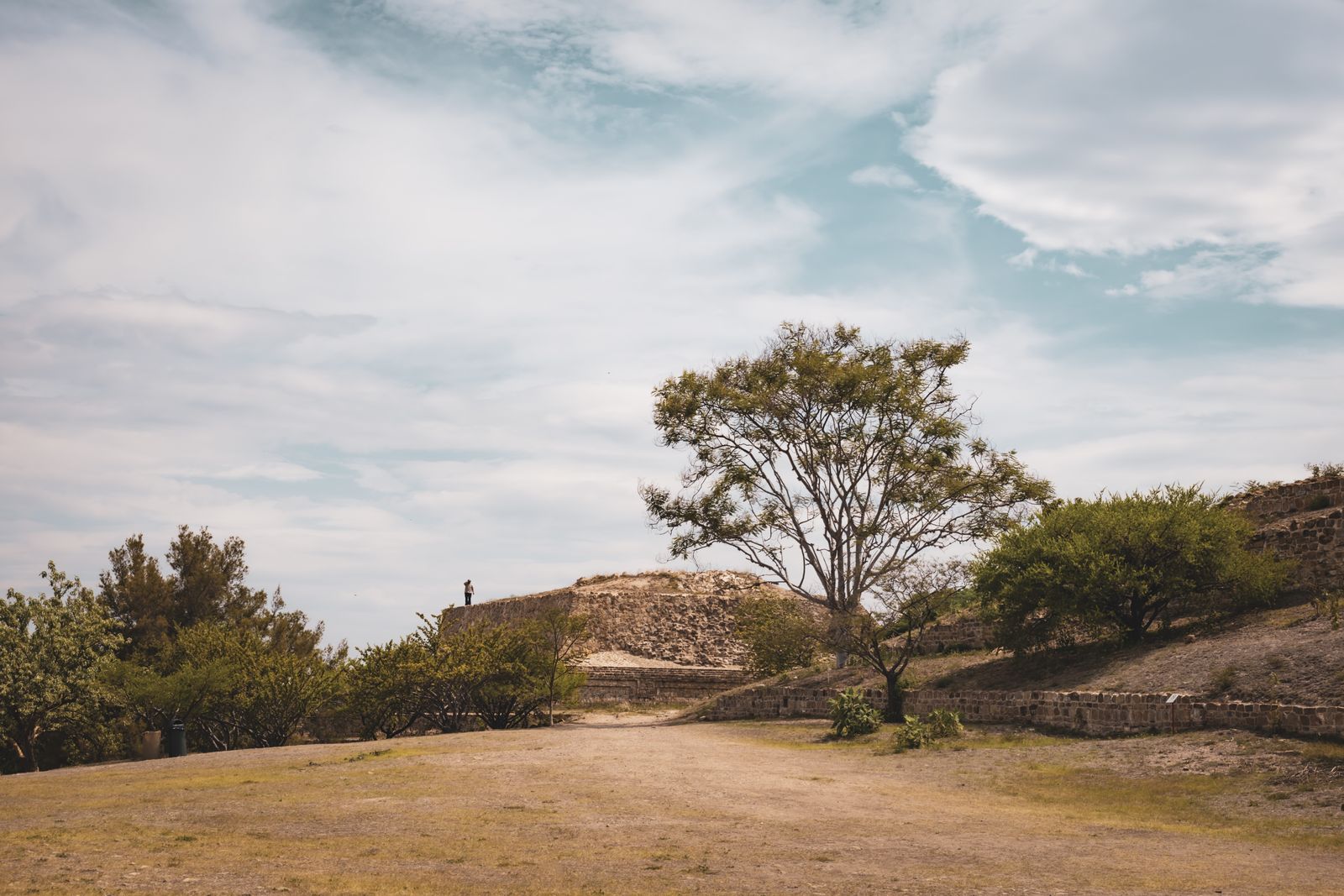
What Is Monte Albán?
Monte Albán is a pre-Columbian Zapotec city built on an artificially leveled mountaintop overlooking the Oaxaca Valley. Construction began roughly 500 BCE, which makes it one of Mesoamerica's earliest planned cities, and it served as the political and ceremonial center of the Zapotec civilization for over a thousand years. The site's Great Plaza is ringed by temple platforms, a ball court, and carved stone monuments, and the elevated position was as much a statement of power as a defensive choice: you can see most of the valley floor from up there.
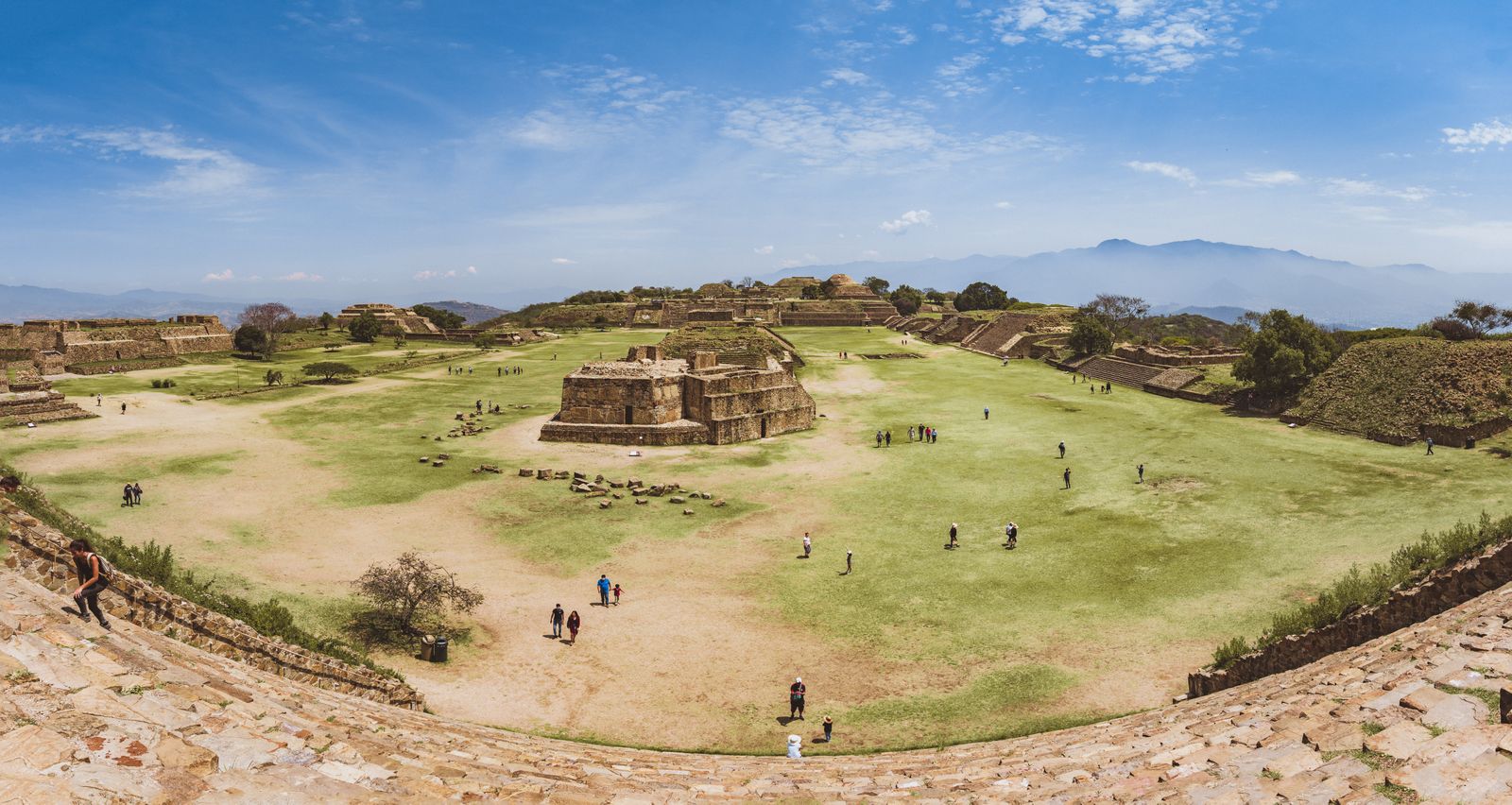
What makes Monte Albán worth the visit isn't just the scale, it's the setting. Few archaeological sites in Mexico put you on a mountaintop with a 360-degree view of the surrounding valley, and the walk across the Great Plaza gives you a sense of just how large and organized this city was for its time.
What Is Mitla, and How Is It Different from Monte Albán?
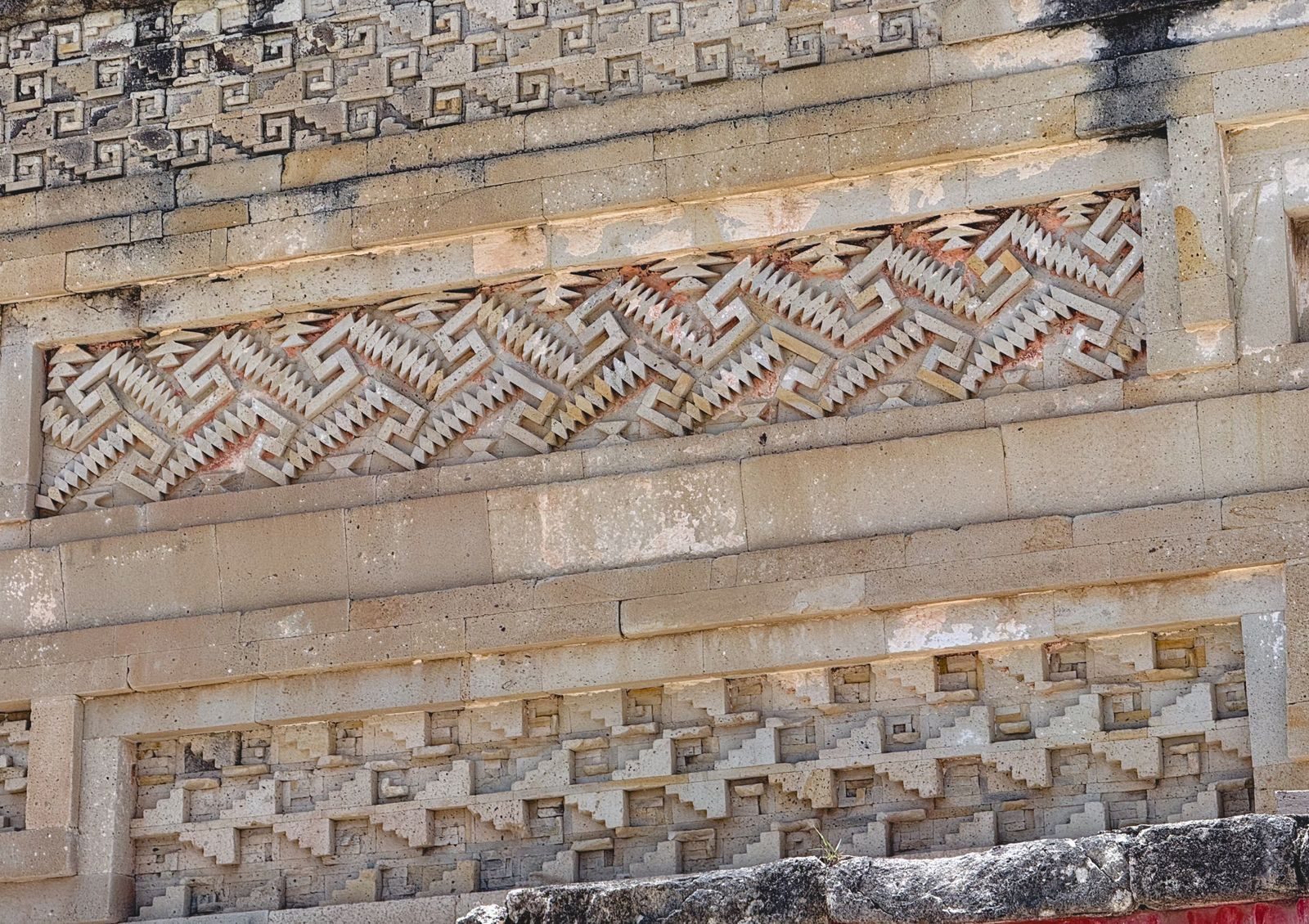
Mitla is a separate Zapotec site, later occupied by the Mixtec, known for the intricate geometric mosaic stonework covering its palace walls. Unlike Monte Albán's open plazas and pyramids, Mitla's buildings are low, tightly arranged structures decorated with thousands of small cut stones set into repeating fret and step patterns, a style found almost nowhere else in Mesoamerica at this level of detail. The site sits roughly 40 to 45 kilometers east of Oaxaca City, in the opposite direction from Monte Albán.
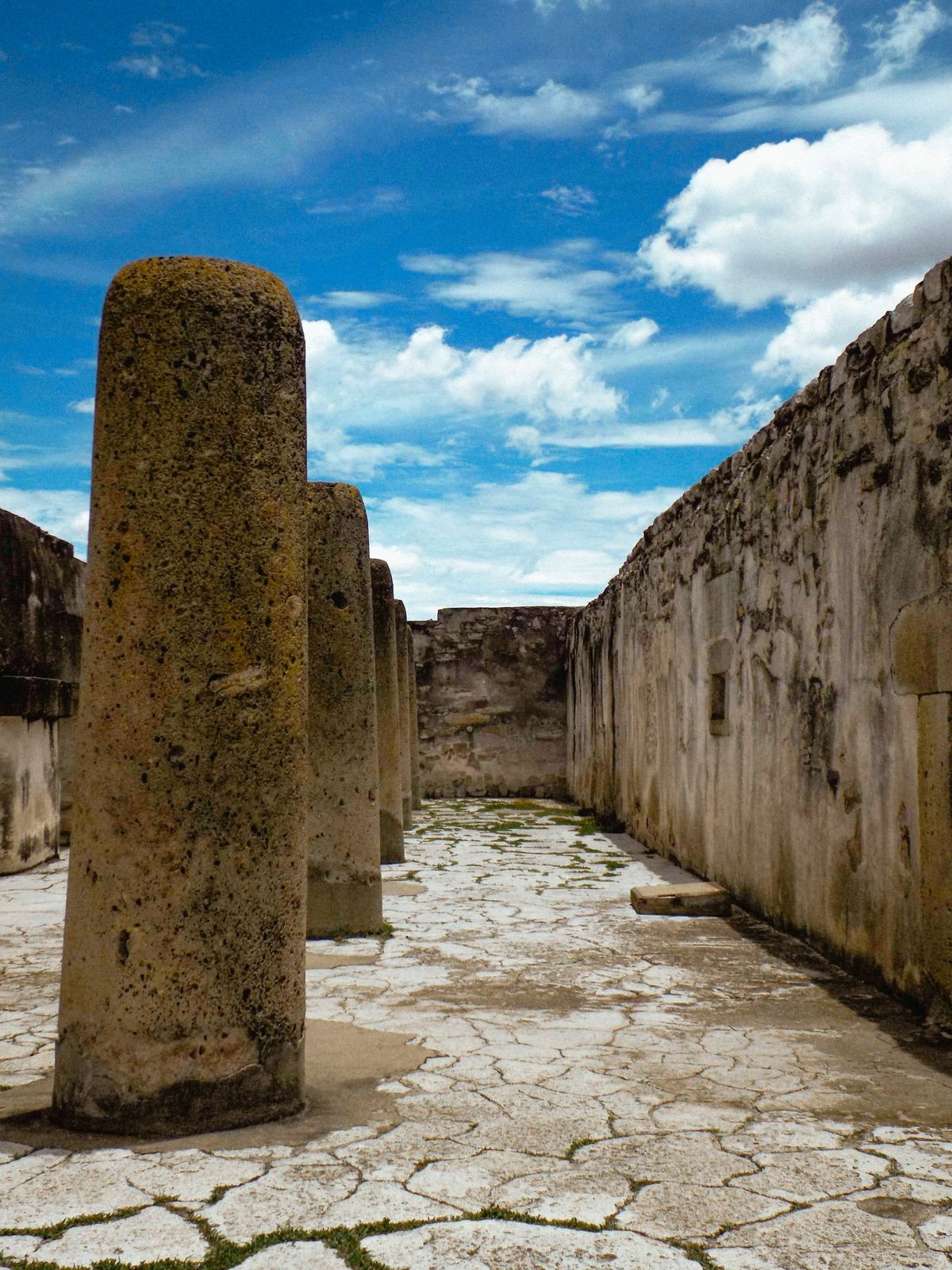
Mitla was still an active religious center when the Spanish arrived in the 16th century, which is part of why the town around it grew up so close to the ruins themselves. That proximity means the site feels different on the ground: you're walking through the middle of a small town rather than climbing a hill removed from everything else.
Can You Really Do Monte Albán and Mitla in One Day?
Yes, but plan for a full day rather than a quick outing. Monte Albán is close to the city and can be seen in two to three hours, while Mitla is farther out and involves more driving time, so combining them realistically takes six to eight hours door to door once you include transportation and a lunch stop.
The order matters. Monte Albán first makes sense for two reasons: it's closer to the city, so you're not backtracking, and it has almost no shade, so getting there early avoids the worst of the midday heat. Mitla, with its smaller footprint and more shaded walkways between structures, is more tolerable in the early afternoon. Doing Mitla first and Monte Albán second usually means arriving at Monte Albán during the hottest, most crowded part of the day, which is the visit most people end up wishing they'd timed differently.
Some tours also add a stop at a mezcal distillery or the Tule Tree between the two ruin sites, since the road out to Mitla passes reasonably close to both. That's worth considering if you want to break up the driving, though it does add time to an already full day.
How Do You Get to Monte Albán and Mitla?
You have four realistic options, and each trades off cost against convenience.
Organized tours are the simplest choice for a one-day combined visit. Most Oaxaca City tour operators run a Monte Albán plus Mitla itinerary (some add Dainzú or a mezcal stop), typically 6-7 hours with hotel pickup and drop-off included. This removes the logistics headache entirely, at a higher cost than doing it independently, check current listings for exact pricing, since it shifts by season and operator.
Colectivos (shared vans) run from designated stops in Oaxaca City to both sites separately. They're the cheapest way to travel independently: fares run roughly 20-30 MXN one-way to Monte Albán, and roughly 25-50 MXN one-way to Mitla (about a 40-50 minute ride), typically departing from stops such as the second-class bus terminal area. You'll need to arrange two separate trips (one to Monte Albán, back to the city, then another out to Mitla) unless you find a route that connects them directly, which isn't standard.
Taxis can be hired for a half-day or full-day rate to take you to both sites with waiting time included. As a rough guide, a one-way taxi to Mitla runs about 400-600 MXN, or 250-300 MXN per hour for a round trip; one traveler reported paying around 2,500 MXN for a private driver covering both sites for a full day, though that's a single data point rather than a fixed rate. This is faster than colectivos and more flexible than a group tour, though it costs more than shared transportation.
Rental cars give you full control over timing, which matters if you want to arrive at Monte Albán right at opening. Roads to both sites are paved and well-marked from Oaxaca City (about 20-30 minutes to Monte Albán, 45-60 minutes to Mitla), though parking at Monte Albán fills up once tour buses start arriving mid-morning.
Figures above reflect a range of traveler and operator reports; colectivo/taxi/tour pricing shifts with fuel costs, season, and pickup point, so confirm same-day pricing with a local operator or the colectivo stand rather than treating these as fixed.
Option | Approx. Cost | Flexibility | Best For |
|---|---|---|---|
Organized tour | Higher than independent options; exact price varies by operator and season | Fixed itinerary, but no logistics to manage yourself | Travelers who want a hands-off trip with hotel pickup and drop-off included |
Colectivo (shared van) | Cheapest option: ~20-30 MXN one-way to Monte Albán; ~25-50 MXN one-way to Mitla | Least flexible: requires two separate round trips, since a direct connecting route isn't standard | Budget travelers comfortable coordinating multiple legs themselves |
Taxi | ~400-600 MXN one-way to Mitla, or ~250-300 MXN/hour for a round trip; one traveler reported ~2,500 MXN for a private driver covering both sites for a full day | More flexible than colectivos and faster, but costs more than shared transportation | Travelers who want speed and flexibility without driving themselves |
Rental car | Rental and fuel costs (not itemized in traveler reports above) | Full control over timing and route | Visitors who want to arrive at Monte Albán right at opening and set their own pace |
What Do Tickets and Entrance Cost?
INAH (Instituto Nacional de Antropología e Historia) manages ticketing and access at both Monte Albán and Mitla, as it does at most archaeological sites in Mexico. As of January 1, 2026, general admission at both sites is 210 MXN for foreign visitors and 105 MXN for Mexican nationals and residents with valid ID, following a nationwide INAH fee increase published in the Diario Oficial de la Federación in late 2025. Children under 13, adults 60 and older, students, teachers, and visitors with disabilities can typically enter free with valid ID. Both sites are open daily from 8:00 am to 5:00 pm, with last entry around 4:00 pm at Monte Albán and 4:30 pm at Mitla. These fee figures reflect the January 2026 INAH increase as reported via secondary sources citing the official gazette; confirm at the gate or via inah.gob.mx before treating this as a hard number.
Sunday admission is sometimes free or discounted for Mexican nationals and residents at INAH-managed sites generally, which can also mean heavier crowds that day; this wasn't confirmed directly on Monte Albán or Mitla's official INAH listing pages, so treat it as a possibility to ask about locally rather than a guarantee. If your schedule is flexible, a weekday visit is generally quieter regardless of the exact fee structure in place when you go.
If you want to build a mezcal stop into the route, our mezcal village tours guide covers combining a Santiago Matatlán stop with this same day.
What Should You Bring?
Pack for sun exposure and walking, since both sites involve time outdoors with limited shade. Monte Albán in particular has almost no cover across its Great Plaza, so a hat, sunscreen, and sunglasses matter more here than at most Oaxaca attractions.
Bring more water than you think you'll need. There are vendors near the entrances of both sites, but not much once you're inside walking the ruins themselves. Comfortable, closed-toe shoes make a real difference too: the terrain at Monte Albán includes uneven stone steps and packed dirt paths, and Mitla's structures involve some low doorways and tight stone passages.
A light day pack for water, snacks, and a camera works better than trying to carry everything in your hands, and cash is useful for entrance fees, parking, and any food stalls near the sites, since card acceptance isn't consistent at either location.
What's the Best Time of Day to Visit?
Early morning is the better call for both sites, but especially for Monte Albán. Arriving close to opening means cooler temperatures, softer light for photos, and noticeably fewer people before tour buses start arriving mid-to-late morning. By midday, the combination of direct sun and larger crowds makes the Monte Albán plaza a much less comfortable place to spend an hour.
Mitla holds up better later in the day since its structures offer more shade between courtyards, which is part of why the Monte Albán-first, Mitla-second order works well logistically and comfort-wise. If you can only choose one site to visit early, make it Monte Albán.
FAQ
Do I need a guide at Monte Albán or Mitla? A guide isn't required at either site, but one adds context that's easy to miss on a self-guided walk, especially at Mitla, where the significance of the mosaic patterns isn't obvious without explanation. Guides are usually available for hire at the entrance of both sites if you'd rather decide in the moment than book ahead.
Is it possible to visit Monte Albán or Mitla without a car or tour? Yes. Colectivos serve both sites from Oaxaca City, and taxis are widely available. It just takes more coordination than joining an organized tour, particularly if you're trying to hit both sites in one day.
Which site should I prioritize if I only have time for one? Monte Albán is the more commonly recommended single stop, since it's closer to the city, easier to reach, and gives a broader sense of Zapotec civic architecture. Mitla is worth prioritizing instead if intricate stonework and a smaller, more intimate site interest you more than scale.
Planning the Rest of Your Trip
Monte Albán and Mitla work well as a single Central Valley day, but they're only one piece of what the region around Oaxaca City has to offer. If you're deciding how to divide your time between ruins, mezcal towns, and artisan villages, our guide to how many days to spend in Oaxaca breaks down realistic itineraries for different trip lengths, and the Oaxaca travel guide covers the rest of what to plan around this day trip.